




MENUMENU
TALK TO AN EXPERT
Special Hours: 7AM – 6PM PST


Upgrading your RV or marine battery system is one of the smartest ways to gain more reliable power—but it’s also one of the easiest places to make costly mistakes. One of the most common (and most critical) is choosing the wrong battery cable size. Battery cables are the backbone of your electrical system and undersized cables can cause voltage drop, overheating, nuisance shutdowns, or even fire risk. Oversized cables can add unnecessary cost, weight, and installation headaches, especially in tight RV or boat compartments.
The good news? Selecting the correct battery cable size doesn’t require guessing or overengineering. It comes down to understanding current draw, cable length, and how your system is actually used.
In this guide, we’ll break down exactly how battery cable sizing works, why it matters even more with modern lithium power systems, and how to confidently choose the right cable size for your RV or boat, so your investment delivers safe, efficient, and dependable power wherever you travel.


There isn’t one universal battery cable size that works for every RV or boat. The correct size depends on several key factors, including how much current your system draws and how far that current has to travel.
Battery cables are the main arteries of your electrical system. Because they connect directly to the battery bank, they carry more current (measured in amps) than almost any other wire onboard, especially in modern setups with lithium batteries, inverters, and solar charging systems. That higher current demand is why battery cables are typically much thicker than standard RV or marine wiring.
If battery cables are undersized, even a high-quality battery system can suffer from voltage drop, overheating, inverter faults, or long-term reliability issues. If they’re oversized, you may add unnecessary cost, weight, and installation difficulty, particularly in tight battery compartments.
Choosing the right battery cable size isn’t about guessing or defaulting to the thickest wire available. It’s about matching the cable to your actual electrical load and cable length.
Below, we’ll break down how to determine your system’s power requirements and use that information to select the proper battery cable size for your RV or marine battery system with confidence.
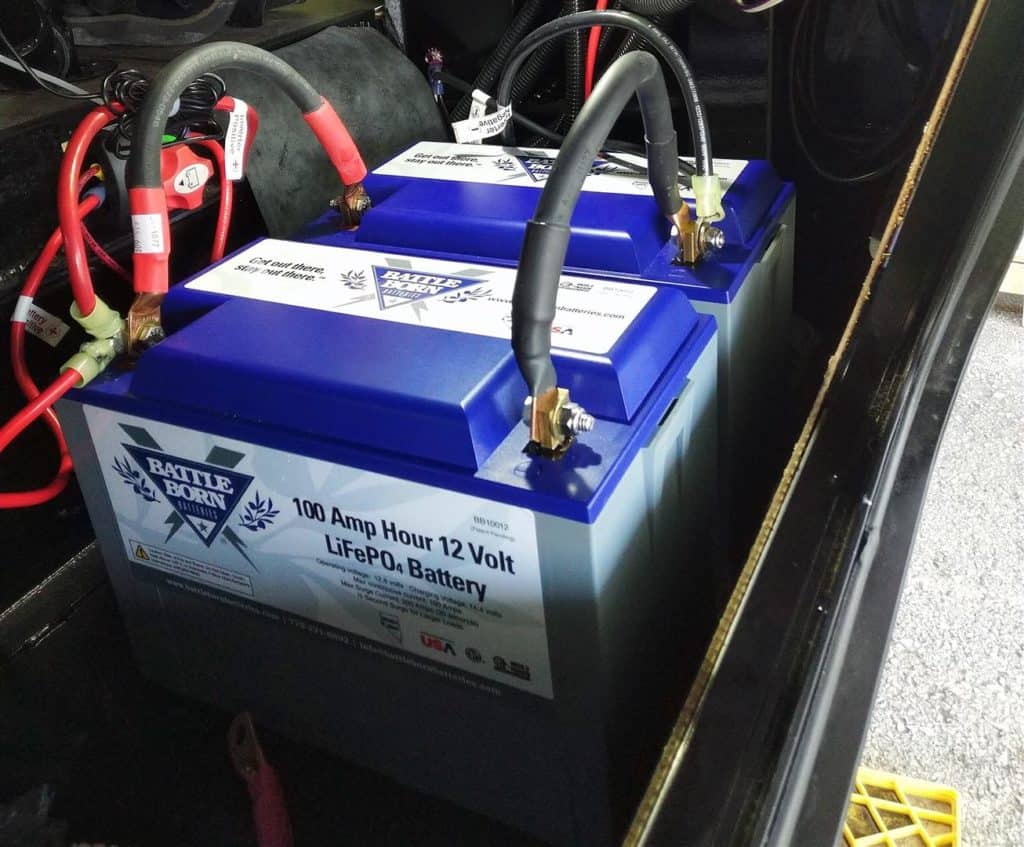
Wire gauge is the measurement of a wire’s diameter or thickness. The US standard for measuring wire gauges is the American Wire Gauge scale, or AWG for short.
In the AWG system, the higher the number of the cable rating, the thinner the wire and, therefore, the less current it can carry.
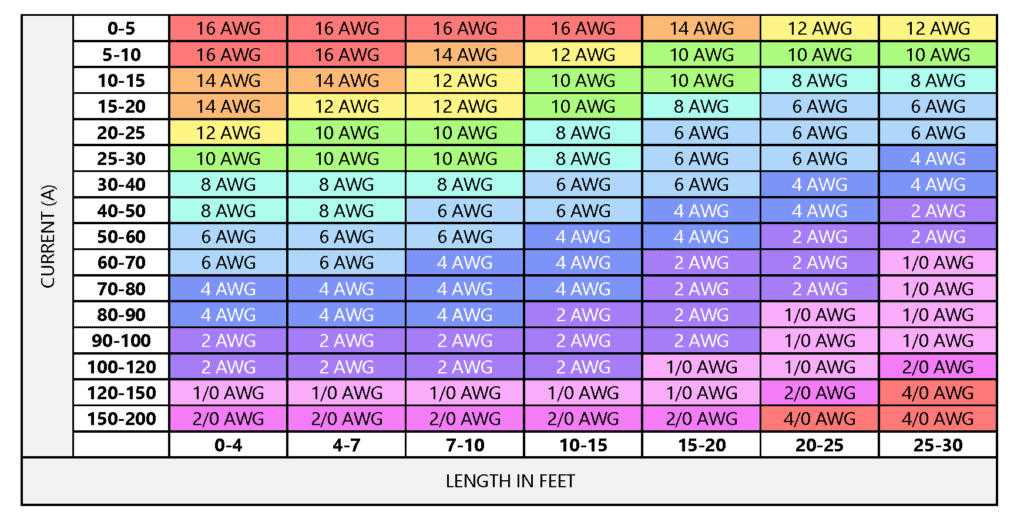
For example, if you look at the chart below, you will see that 12 AWG, which has a diameter of 2.05 mm, can carry 20-25 amps up to 4 feet. 14 AWG, which has a diameter of 1.62 mm, can only carry 15-20 amps the same distance. Distance is important because it adds resistance in the wires and will drow the voltage. This chart we created gives the appropriate wire size to stay within acceptable voltage drop and current limits. Let’s now learn more about what these sizes really mean.
Thicker wires can carry more current for longer distances. Without getting into the math behind it, the reason for this is that a cable’s resistance increases as its diameter decreases or the length increases.
Therefore, the size cable you need depends on two things: how much current you need to carry and how long your cable runs need to be. This is why the AWG sizing chart lists the different current capacities at various lengths. As the cable length increases, so does the required cable thickness.
Wires have a maximum voltage rating as well. However, since your RV battery cables will only be between 12 and 48 volts, you do not need to worry about the voltage rating when determining which battery cable size to use. (Most cables are rated for a minimum of 250 volts)
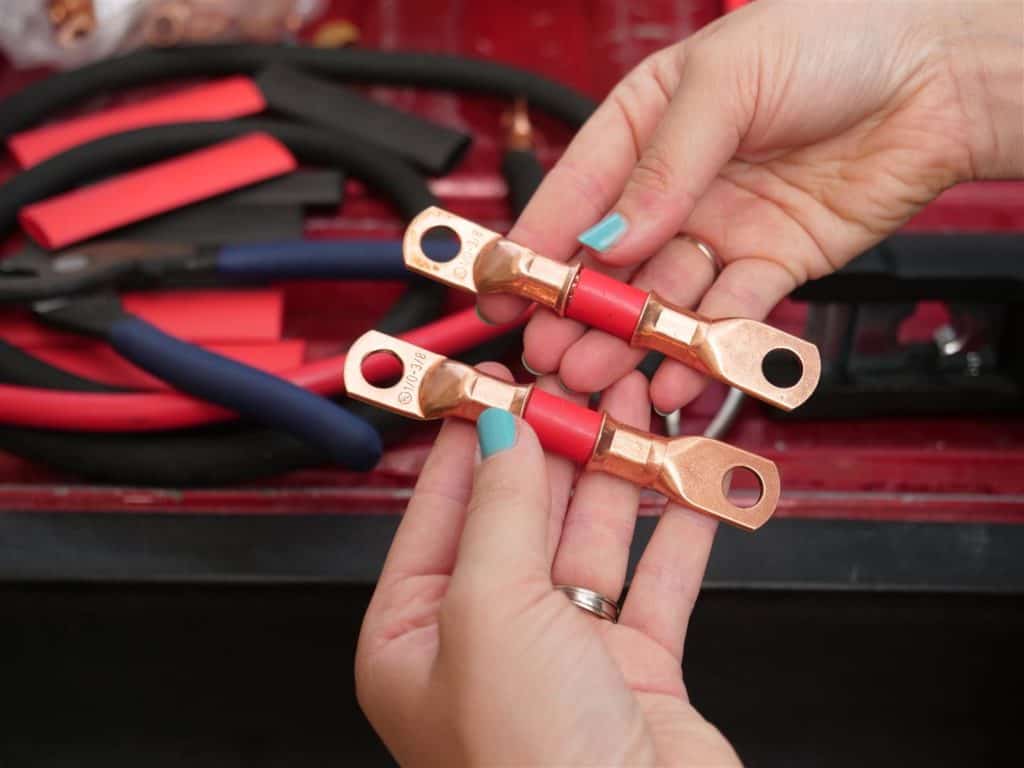
As we mentioned earlier, thicker wires have lower resistance. Resistance in a wire causes two main things to happen as current passes through it.
The first is that a voltage drop occurs when the current increases. This means that the voltage at the end of the wire is lower than the voltage at the battery. If you have too much drop in voltage, your electronics will not work.
The voltage drop in a wire is calculated using Ohm’s law, V=I*R. V is voltage drop, I is the current passing through the wire, and R is the wire’s resistance. As you can see, if you increase the current, the resistance, or both, you will increase your voltage drop.
Resistance in a wire is dependent on both the thickness (the gauge) and the total length of the wire. If you undersize your battery cables, one issue that can occur is an excessive voltage drop that may prevent your electronics from working.
The second thing that happens as current passes through a wire is that heat is generated. Much like voltage drop, more resistance in the wire results in more heat being generated. If wires are undersized, they can get so hot that the casing melts and can cause a fire. Fires are much more catastrophic than too much voltage drop and are the main risk in choosing too small of a battery cable.
Having wire that is overrated for the amperage helps protect wires from overheating and potentially igniting. While it’s better to be safe than sorry when it comes to wire gauge, going too big has some drawbacks as well.
There are three main drawbacks to choosing a battery cable wire gauge that is too big: cost, weight, and ease of use.
Probably the most significant consideration is cost. Thicker wire gauges cost more. If you are only running a few feet of battery cable, the additional cost will be insignificant. As cable runs get longer, cost becomes more of a consideration.
Similar to cost, as the wire gauge increases, so does the weight. Again, if your cable runs are short, the added weight will be negligible.
The last drawback to using thicker cable is that working with it is more challenging. Trying to bend and manipulate overly thick cabling in small, cramped compartments is not a fun time.
The drawbacks to oversizing your battery cabling are much less risky than choosing cables that are too small. However, choosing excessively thick cables can add unnecessary cost, weight, and frustration to your project. While it’s smarter and safer to choose too big rather than too small, just picking the thickest cable you can find isn’t a great strategy either.
When sizing battery cables, you must size for the maximum current your system is capable of drawing, not what you plan to use day to day.
Battery cables don’t care about intentions; they only respond to electrical demand. If a component can pull a certain amount of current, your cables must be able to safely handle that load whenever it occurs.
In RV battery systems, the largest current draw almost always comes from the inverter. Even though the inverter powers AC appliances, the cables connected to your batteries only see DC current, and that DC current can be substantial.
For example, a 3,000-watt inverter connected to a 12-volt battery system can draw roughly:
And that’s before accounting for inverter inefficiency, surge loads, or voltage sag. In real-world conditions, momentary current draw can be even higher.
Even if you don’t plan to run the inverter at its full 3,000-watt output, your battery cables still need to be sized as if you might. Appliances start unexpectedly, loads stack up, and surge currents happen in milliseconds, long before a breaker trips or you realize something is running.
If your inverter is rated for 3,000 watts, your battery cables must be capable of handling the full DC current that inverter can demand.
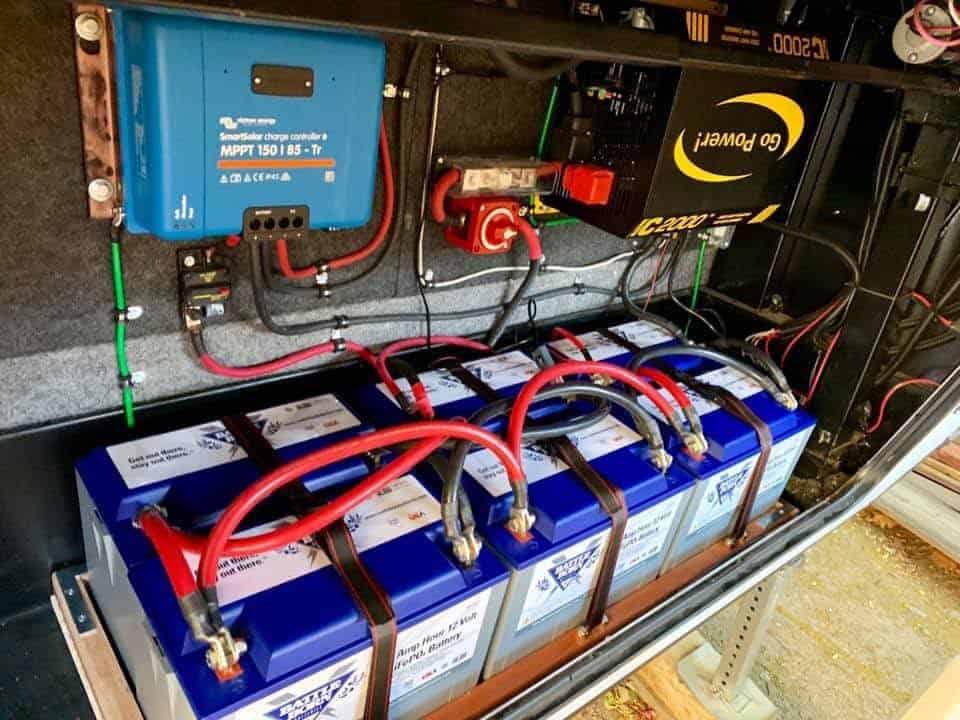
While the inverter is usually the largest load, other components can also contribute to peak current draw, including:
When determining your required cable size, always consider the largest single load or combination of loads that could reasonably occur at the same time.
A common mistake is sizing battery cables based on average usage or typical appliance draw. This can lead to voltage drop, nuisance inverter shutdowns, excessive heat, or premature cable failure.
Battery cables should always be sized for worst-case conditions, not best-case scenarios.
Once you know the maximum DC current your system can draw and the length of your cable runs, choosing the correct battery cable size becomes straightforward.
Choosing the correct battery cable gauge comes down to two factors:
Once you know those two numbers, selecting the proper wire gauge is straightforward using a wire sizing chart.
One important concept that’s often misunderstood is that current is additive as circuits come together.
Think of your electrical system like a river:
This is why smaller downstream circuits can safely use smaller wire gauges and fuses, while the main battery cables must be much larger. Even though no single appliance may draw hundreds of amps on its own, all system current ultimately passes through the cables connected directly to the batteries.
Because of this, the largest cables in the system are almost always the battery cables.
In real-world RV and marine installations, it’s very common to see battery interconnects and inverter cables sized at 2/0 or 4/0 AWG. This isn’t overkill, it’s intentional.
Oversizing battery cables:
Because battery cable runs are typically short, the added cost and weight of using heavier cable is often minimal compared to the performance and reliability benefits.
While current determines how thick a cable must be, distance determines how quickly voltage drop becomes a problem. Longer cable runs require thicker wire to maintain the same voltage at the load.
That’s why wire sizing charts list allowable current at various cable lengths. As distance increases, the required wire gauge increases as well — even if the current stays the same.
Whenever possible:
You can use a wire sizing chart to select the appropriate battery cable gauge. Lower current and shorter distances allow for smaller cables, while higher current or longer distances require thicker wire.
If you’re ever unsure, choosing the next size larger is usually the safer option — especially at the battery and inverter connections where current is highest.
When in doubt, reach out to a qualified installer or a Battle Born technical specialist. Guessing on cable size is never the right solution.
RV battery cables are a small but essential part of a complex and integral system in your RV. Choosing the wrong size battery cable can lead to extra cost, frustration, and potentially even a fire.
However, picking the correct battery cable size for your system doesn’t need to be stressful. Use the tips above or reach out to a Battle Born expert with any questions to help make your RV battery upgrade project a success!
We know that building or upgrading an electrical system can be overwhelming, so we’re here to help. Our Reno, Nevada-based sales and customer service team is standing by at (855) 292-2831 to take your questions!
Also, join us on Facebook, Instagram, and YouTube to learn more about how lithium battery systems can power your lifestyle, see how others have built their systems, and gain the confidence to get out there and stay out there.


18 thoughts on “What Battery Cable Size Should I Use?”
In the above wire gauge table you refer to ‘cable length’. Is this a two conductor cable?
If so, please confirm the table accounts for the total resistance (current running to and from the load) vs running a single conductor with local ground?
Hi Bill, thanks for reaching out and I apologize for the delay in getting back to you. If you give our sales and tech team a call at 855-292-2831 we certainly can help with any wiring assistance that you may need.
I am going to run two 12 v batteries to my camp trailer the cables that are on the trailer are two guage can I use 4 guage for the cross over from one battery to the other?
Hi Jesse! Thanks for reaching out. Our team notes that 4 gauge is too skinny of a wire and the skinniest you can use is 1/0. If you’d like additional information or assistance please give our sales and tech team a call at 855-292-2831 and they’ll be ready and willing to help.
Hi, I am looking for the correct wire size for 400ah battery string at 12v. Hoping you can help. By the way we are loving the batteries and adding two more. Thanks in advance.
Good morning Philip, thank you for reaching out. Our team suggests that 2/0 is a good wire size for your current system, and it works if you have plans to grow the system in the future. Please let us know if you have any additional questions.
I am preparing to replace a 2000 watt inverter/converter on my RV. In preparation I am looking at needing to add ring lugs to the 12 volt cables currently secured by set screws in the existing inverter/converter. The cable diameter with insulation is about 5/8″. Is that equivalent to 4/0 cable? Can I use ring lugs that attach with set screws rather than trying to crimp on in the limited space available?
Good morning Dave! This is a great question. Our team suggests that 4/0 should be fine but please note that our batteries ship with 18-8 stainless steel 5/16 – 18 1” and 1 ¼” bolts, brass washers, and 18-8 stainless steel nuts with nylok inserts. If you have a bank of under 6 batteries, we suggest using 2/0 cable, but if you have 6 or more then 4/0 will work great. If you have any other questions about the install, please give our team a call at 855-292-2831.
Hi, I have a van conversion I am building. I have 1 205w solar panel, 1 100ah lipoe4 battery,a small 500w inverter. I will power a maxair fan, 12v compressor fridge and a few led lights. Everything is within 2 fet of battery. Will 4awg cable be ok?
Hi Mike, I apologize in the delay in getting back to you. Please give our technical sales team a call at 855-292-2831 and they will be able to assist with any issues you may be experiencing in your van build.
Having 12 volt in my motor home. 8 house batteries one year old. When installed, I question the installer about the size of the wires between batteries(new wires). They are a lot smaller than previous ones. Have been hooked up to 50 amp service for this year. I’ve been having 12 volt problems during this time, fans working some times, not others. Could these smaller red wires be a part of the problem? It seems that the batteries discharge fast when the power goes off between that and the time it takes to start the generator.
Hi Ron. It is possible that the smaller cables could be part of the problem causing your fans to not work at times. One issue that can occur when battery cables are too small is an excessive voltage drop that may prevent electronics from working.
Hello. I am upgrading my house bank to four 105 amp/hr batteries, 420 amp/hrs total. My wire run is 12 ft one way , from the batteries through the battery switch and then to my main DC panel. I have calculated my total required DC load for the boat to be 200 amp/ hrs.
What size wire do I require to connect the batteries in parallel and the wire size from the batteries to the main panel?
I will be connecting 3 170ah batteries in parallel, what cable would be best to connect the batteries to each other? Is 2/0 okay?
I have a 3000 watt pure sine inverter and max load I’ll ever have is about 3000watts @ 120v and only 600 watts @ 12v.
Hi…I have a composting toilet that has a fan in it. I would like to connect it to a 12 volt battery. What size gauge do I need. It will run about 15 ft from fan to battery. Thanks for any feedback .
Hi Barb! The gauge wire size you need can be determined by first finding out the current rating (A) of the fan. Then locate that current rating on the chart above that corresponds to the column for a 15ft wire.
I have a rv that plugs into a 50 amp shore line a 2000 wt inverter and only 1 12 v battery I am replacing that battery with 2 100 ah 12 v batteries from y’all. What gauge jumper wire should I have made to connect the 2 batteries in parallel?
Hi Mark! Check out this blog to learn more about how to determine the right cable size for your batteries, https://battlebornbatteries.com/battery-cable-size/. If you have further questions, our technical sales team can help you at (855) 292-2831 (M-F 8:00am -4:30pm (PST).